

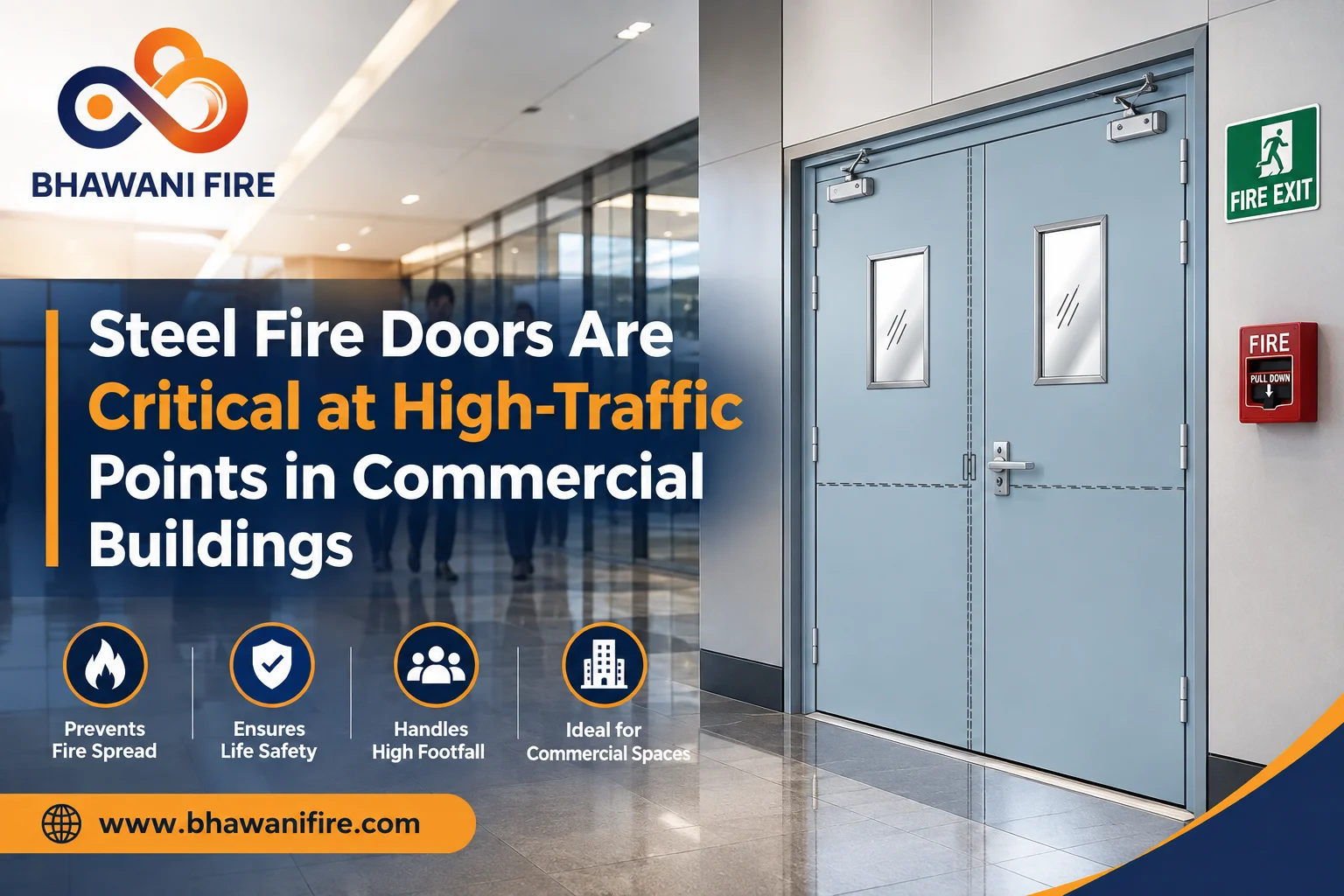
Commercial buildings face heavy human traffic due to constant movement throughout the day. The doors at their entrances, staircases, corridors, and other places are being used hundreds of times, making them prone to frequent wear and tear. And these same doors also become the route for fire and smoke if a fire breaks out. That is when the steel fire doors for commercial buildings become particularly important, due to their strong protective barrier and their capability to hold fire and smoke. Let’s understand more through this blog what makes these steel fire doors a better choice for high-traffic areas.
High-traffic areas and fire safety
Busy areas can become particularly important during a fire emergency. Corridors connect different rooms, staircases provide escape routes and service areas may contain electrical or mechanical equipment. If fire and smoke move freely through these spaces, occupants may have less time to reach a safe location. Properly positioned fire doors help create separation between different sections of a building.
Steel construction for busy commercial spaces
Commercial doors are opened and closed repeatedly throughout the day. A door installed at a busy entrance or passage therefore needs to handle regular operation without compromising its protective function. Steel provides the strength required for demanding environments. Steel fire doors for commercial buildings combine robust construction with fire-resistant properties, making them suitable for offices, commercial complexes, hospitals, educational institutions, hotels, retail spaces and industrial facilities.
Protection against fire and smoke movement
One of the key roles of a fire door is to delay the movement of fire and smoke between separated areas. At high-traffic points, this becomes even more important because these locations can connect multiple occupied spaces. When a fire door is closed, it can act as a barrier that helps contain the emergency within a particular section for a limited period. This can provide occupants with additional time to move towards safer areas.
Staircases and corridors as protected routes
Staircases and corridors deserve particular attention because they are commonly used for evacuation. Smoke entering these routes can make movement difficult and reduce visibility. Steel fire doors installed at appropriate access points can help protect these routes by restricting the movement of smoke and flames. Their effectiveness depends on correct fire rating, suitable hardware, proper fitting and regular maintenance.
Frequent use makes door performance important
A fire door at a high-traffic location must function properly every day, not only during an emergency. A door that remains open, does not close correctly or has damaged seals may not provide the intended level of protection. For this reason, commercial properties should pay attention to door closers, hinges, seals, frames and other components. Regular inspection is particularly important where doors experience heavy daily use.
Conclusion
High-traffic points deserve careful attention in every commercial fire safety plan. Steel fire doors for commercial buildings provide a durable barrier that can help restrict fire and smoke movement while protecting important routes within a property. With the right fire rating, compatible hardware, proper installation and regular maintenance, these doors can become an important part of passive fire protection. We at Bhawani Fire Protection Pvt. Ltd. offers steel fire doors with enhanced durability and fire protection. Our fire door solutions are designed for demanding commercial applications and help strengthen passive fire safety at important access and separation points.
FAQs – Frequently Asked Questions
Their robust construction makes them suitable for locations that experience frequent use while providing specified fire resistance.
Staircases, corridors, electrical rooms, storage areas, utility spaces and other designated fire separation points commonly use fire doors.
Yes, when equipped with suitable seals and correctly installed, they can help restrict the movement of smoke through protected areas.
Yes, incorrect fitting, unsuitable hardware or gaps around the frame can affect the door’s intended fire performance.
They should be checked regularly, particularly in high-traffic locations, to identify damage, alignment issues, worn seals or problems with closing mechanisms.